
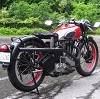
To attach badges Ariel spot welded a strip of steel in the depression with a hole at each end for the screws. The heads of the screws were then soldered over so the surface looked more like the head of a rivet. I have a similar tank and used double sticky tape or RTV (or both) to hold on the badges.
Funny what Roger says about making badges! Glad Draganfly are doing it.
1946 VH 500 Restoration
Re: 1946 VH 500 Restoration
1937 Guzzi GTV, 1937 NG, 1946 VH bitsa, 1947 VH, 1974 Guzzi Eldorado, 2002 Guzzi Lemans
-
paul.jameson

- Holder of a Golden Anorak

- Posts: 3202
- Joined: Wed Oct 12, 2011 3:04 pm
- Location: Herefordshire
- Contact:
Re: 1946 VH 500 Restoration
I believe that the soldering over of the badge screws was done to prevent the screws from coming out and the badges falling off. Actually doing the soldering over is not too easy. An electric soldering iron hasn't enough power, and neither has a miniature blow lamp. a full size blow lamp will do the job, but will also remove the paint from your newly painted tank. the answer is to use the old fashioned type of soldering iron which was traditionally heated using a gas ring. That will do the job, but making the head of the blob of solder semi-hemispherical is a matter of luck, in my case.
Another option is to use screws (available from AOMCC regalia) which have a rounded head to replicate the solder blob. I found they worked perfectly and only did the solder blob as an exercise in proving it could be done.
Another option is to use screws (available from AOMCC regalia) which have a rounded head to replicate the solder blob. I found they worked perfectly and only did the solder blob as an exercise in proving it could be done.
Paul Jameson
34 OHC 4F 600 (project), 35 LG 250, 37 RH500, 52 ex ISDT KHA, 54 KH(A), 75 Healey 1000/4.
Former Machine Registrar & Archivist, General Secretary and Single Spares Organiser (over a 25 year period).
Now Archivist (but not Machine Registrar), Gauges and Clocks Spares Organiser.
34 OHC 4F 600 (project), 35 LG 250, 37 RH500, 52 ex ISDT KHA, 54 KH(A), 75 Healey 1000/4.
Former Machine Registrar & Archivist, General Secretary and Single Spares Organiser (over a 25 year period).
Now Archivist (but not Machine Registrar), Gauges and Clocks Spares Organiser.
-
KenS

- Holder of a Nylon Anorak

- Posts: 142
- Joined: Sat Nov 02, 2024 2:41 pm
- Location: Texas, USA
- Contact:
Re: 1946 VH 500 Restoration
Along with the badges were other transfer's and I'm not sure if the two on the lower right are for my tank. They are inverted and I'm not sure how I would apply them if they are the correct ones. Wet them with water perhaps?
- Attachments
-
1946 VG 500
-
KenS
- Holder of a Nylon Anorak
- Posts: 142
- Joined: Sat Nov 02, 2024 2:41 pm
- Location: Texas, USA
- Contact:
Re: 1946 VH 500 Restoration
Paul, I remember those large old copper soldering irons, I used them during my school metalwork class in the 60's and electrical apprenticeship back in 1972. Doubt I'd find any nowadays!paul.jameson wrote: Fri Dec 13, 2024 10:20 am I believe that the soldering over of the badge screws was done to prevent the screws from coming out and the badges falling off. Actually doing the soldering over is not too easy. An electric soldering iron hasn't enough power, and neither has a miniature blow lamp. a full size blow lamp will do the job, but will also remove the paint from your newly painted tank. the answer is to use the old fashioned type of soldering iron which was traditionally heated using a gas ring. That will do the job, but making the head of the blob of solder semi-hemispherical is a matter of luck, in my case.
IMG_71931.jpg
Another option is to use screws (available from AOMCC regalia) which have a rounded head to replicate the solder blob. I found they worked perfectly and only did the solder blob as an exercise in proving it could be done.
1946 VG 500
-
KenS
- Holder of a Nylon Anorak
- Posts: 142
- Joined: Sat Nov 02, 2024 2:41 pm
- Location: Texas, USA
- Contact:
Re: 1946 VH 500 Restoration
What font is the ARIEL lettering. I could check to see if I can have some printed at my local sign shop
1946 VG 500
-
Roger Gwynn

- Holder of a Golden Anorak
- Posts: 2098
- Joined: Tue May 28, 2013 11:34 am
- Location: Norwich, UK
- Contact:
Re: 1946 VH 500 Restoration
A guide to which transfers and their location is here https://draganfly.co.uk/product-categor ... s-4stroke/ and on the club website
Roger Gwynn, caretaker of the club's works drawings and machine register, membership secretary 2015-26. Director of AOMCC, Draganfly Motorcycles, Craven Equipment and Supreme Motorcycles mostly retired.
-
KenS
- Holder of a Nylon Anorak
- Posts: 142
- Joined: Sat Nov 02, 2024 2:41 pm
- Location: Texas, USA
- Contact:
Re: 1946 VH 500 Restoration
Thank you for pointing out the Dragonfly page Roger. I found a photo of the tank before it was re-chrome plated which clearly shows it has a transfer in white, but can't tell if that was blue in the lettering.
- Attachments
-
1946 VG 500
-
chris.shearwood

- Holder of a Silver Anorak

- Posts: 709
- Joined: Mon Feb 28, 2011 5:28 pm
- Location: Sutton, Quebec, Canada
- Contact:
Re: 1946 VH 500 Restoration
Hello Ken,
There is some more info on tank badges in an old thread:
viewtopic.php?t=3187
I'll attach a couple of photos of my Sq4 tank as the photos from the old thread are not showing properly (at least on my computer!).
Regards, Chris
There is some more info on tank badges in an old thread:
viewtopic.php?t=3187
I'll attach a couple of photos of my Sq4 tank as the photos from the old thread are not showing properly (at least on my computer!).
Regards, Chris
- Attachments
-
-
-
Roger Gwynn
- Holder of a Golden Anorak
- Posts: 2098
- Joined: Tue May 28, 2013 11:34 am
- Location: Norwich, UK
- Contact:
Re: 1946 VH 500 Restoration
Scroll down the page and you will find applications and colours.
Either red or blue shading, TRA-20 or 21 (excuse the misprint in the caption) I would expect the red to be used on red tanks, normally found on Hunters and the Blue on other models. Incidentally the first enamel badge in 1934 had blue shading, changed the following year to black when the red shaded ones were invented for the Hunters.
Either red or blue shading, TRA-20 or 21 (excuse the misprint in the caption) I would expect the red to be used on red tanks, normally found on Hunters and the Blue on other models. Incidentally the first enamel badge in 1934 had blue shading, changed the following year to black when the red shaded ones were invented for the Hunters.
Roger Gwynn, caretaker of the club's works drawings and machine register, membership secretary 2015-26. Director of AOMCC, Draganfly Motorcycles, Craven Equipment and Supreme Motorcycles mostly retired.
-
Julian Murphy
- Holder of a Waxed Cotton Anorak

- Posts: 536
- Joined: Fri Aug 14, 2020 1:42 pm
- Contact:
Re: 1946 VH 500 Restoration
Yea. All well talking about soldering screw head slots....but....the OP does not have the thin backing strip, in the badge recess, with threaded holes to screw into.
So four options:
- Waterslide transfer and clearcoat over this,
- Fit the badge as found in the OP's toolbox with double sided tape leaving the screw holes unfilled,
- Make dummy screws without a slot in the head :
fitted to the badge either by 'bonding' in place, or if the badge is thick enough thread the hole in the badge, maybe only 1 or 2 threads and threadlock in place.
- Make dummy screws without a slot in the head, just long enough to protrude throuh the back of the badge and peen over in 3 places.
So four options:
- Waterslide transfer and clearcoat over this,
- Fit the badge as found in the OP's toolbox with double sided tape leaving the screw holes unfilled,
- Make dummy screws without a slot in the head :
fitted to the badge either by 'bonding' in place, or if the badge is thick enough thread the hole in the badge, maybe only 1 or 2 threads and threadlock in place.
- Make dummy screws without a slot in the head, just long enough to protrude throuh the back of the badge and peen over in 3 places.
Who is online
Users browsing this forum: No registered users and 1 guest